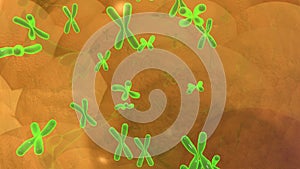
In the nucleus of each cell, the DNA molecule is packaged into thread-like structures called chromosomes. Each chromosome is made up of DNA tightly coiled many times around proteins called histones that support its structure. Chromosomes are not visible in the cellââ¬â¢s nucleusââ¬ânot even under a microscopeââ¬âwhen the cell is not dividing. However, the DNA that makes up chromosomes becomes more tightly packed during cell division and is then visible under a microscope. Most of what researchers know about chromosomes was learned by observing chromosomes during cell division. Each chromosome has a constriction point called the centromere, which divides the chromosome into two sections, or ââ¬Åarms.ââ¬Â The short arm of the chromosome is labeled the ââ¬Åp arm.ââ¬Â The long arm of the chromosome is labeled the ââ¬Åq arm.ââ¬Â The location of the centromere on each chromosome gives the chromosome its characteristic shape, and can be used to help describe the location of specific genes.
|