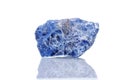
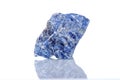
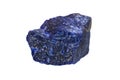
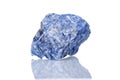
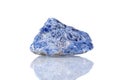
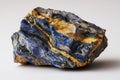
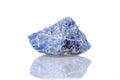
SodaliteÃÂ is a rich royal blue tectosilicateÃÂ mineral, widely used as anÃÂ ornamentalÃÂ gemstone. Although massive sodalite samples are opaque, crystals are usually transparent to translucent. Sodalite is a member of the sodalite group withÃÂ hauyne,ÃÂ nosean,ÃÂ lazuriteÃÂ andÃÂ tugtupite.
First discovered by Europeans in 1811 in theÃÂ Ilimaussaq intrusive complexÃÂ inÃÂ Greenland, sodalite did not become important as an ornamental stone until 1891 when vast deposits of fine material were discovered inÃÂ Ontario, Canada.
Sodalite is a cubic mineral which consists of an aluminosilicate cage network with Na+ÃÂ cations in the interframework. This framework forms a cage structure, similar toÃÂ zeolites. Each unit cell contains two cage structures.[5]ÃÂ Natural sodalite holds primarilyÃÂ chlorideÃÂ anions in the cages, but they can be substituted by other anions such asÃÂ sulfate,ÃÂ sulfide,ÃÂ hydroxide,ÃÂ trisulfurÃÂ with other minerals in the sodalite group representing end member compositions.
|