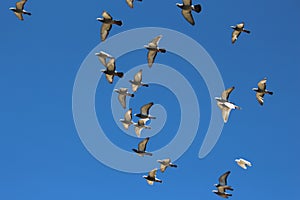
The bird`s forelimbs the wings are the key to flight. Each wing has a central vane to hit the wind, composed of three limb bones, the humerus, ulna and radius. The hand, or manus, which ancestrally was composed of five digits, is reduced to three digits digit II, III and IV or I, II, III depending on the scheme followed[5], which serves as an anchor for the primaries, one of two groups of flight feathers responsible for the wing`s airfoil shape. The other set of flight feathers, behind the carpal joint on the ulna, are called the secondaries. The remaining feathers on the wing are known as coverts, of which there are three sets. The wing sometimes has vestigial claws. In most species these are lost by the time the bird is adult such as the highly visible ones used for active climbing by hoatzin chicks, but claws are retained into adulthood by the secretarybird, screamers, finfoots, ostriches, several swifts and numerous others, as a local trait, in a few specimens.
|