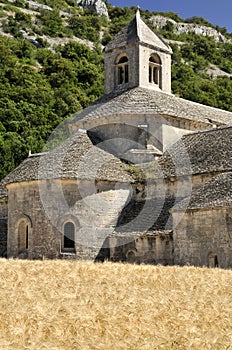
Sénanque Abbey is a Cistercian abbey near the village of Gordes in the département of the Vaucluse in Provence, France. It was founded in 1148 by Cistercian monks who came from Mazan Abbey in the Ardèche. Temporary huts housed the first community of impoverished monks. By 1152 the community already had so many members that Sénanque was able to found Chambons Abbey, in the diocese of Viviers. The young community build the abbey church, consecrated in 1178. Other structures at Sénanque followed, laid out according to the rule of Cîteaux Abbey, mother house of the Cistercians. Among its existing structures, famed examples of Romanesque architecture, are the abbey church, cloister, dormitory, chapterhouse and the small calefactory, the one heated space in the austere surroundings, so that the monks could write, for this was their scriptorium. A refectory was added in the 17th century The abbey is a remarkably untouched survival, of rare beauty and severity: the capitals of the paired columns in the cloister arcades are reduced to the simplest leaf forms, not to offer sensual distraction. At the French Revolution the abbey's lands were nationalized, the one remaining monk was expelled and Sénanque itself was sold to a private individual. A small community returned in 1988 as a priory of Lérins. The monks who live at Sénanque grow lavender and tend honey bees for their livelihood. It is possible for individuals to arrange to stay at the abbey for spiritual retreat.
|