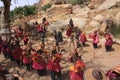
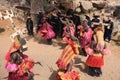
The Dogon are a group of people living in the central plateau region of Mali, south of the Niger bend near the city of Bandiagara in the Mopti region. They number just under 800,000.The Dogon are best known for their mythology, their mask dances, wooden sculpture and their architecture. Their traditional funeral rituals or ââ¬Ådamasââ¬Â are becoming very rare. They may be performed years after the death. Damas that are still performed today are not usually. The Dogon use this entertainment to The traditional dama consists of a masquerade that essentially leads the souls of the departed to their final resting places through a series of ritual dances and rites. Dogon damas include the use of many masks and statuettes. The dama consists of an event, known as the Halic, immediately after the death of a person and lasts for one day (Davis, 68). According to Shawn R. Davis, this particular ritual incorporates the elements of the yingim and the danyim. During the yincomoli ceremony, a gourd is smashed over the deceasedââ¬â¢s wooden bowl, hoe, and bundukamba, (burial blanket), which announces the entrance of the masks used in this ceremony while the deceased entrance to their home in the family compound is decorated with ritual elements (Davis, 72-73). Masks used during the yincomoli ceremony include the Yana Gulay mask, the Satimbe mask, the Sirigie mask, and the Kanaga mask.
|