leaning tower pisa

navigate by keyword : arch architecture belltower campanile column europe foundation italy leaning pisa renaissance soil tilt tower travel tuscany

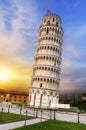
Leaning Tower of Pisa at sunset Royalty Free Stock Photo
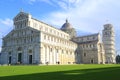
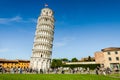
Cathedral and leaning tower in Pisa, Italy Royalty Free Stock Photo
Leaning tower of Pisa, Italy Royalty Free Stock Photo
Leaning tower of Pisa in Tuscany Italy Royalty Free Stock Photo
Leaning tower of Pisa Royalty Free Stock Photo
The Leaning Tower, Pisa Royalty Free Stock Photo
Photo of Leaning Tower of Pisa, Italy Royalty Free Stock Photo
Leaning Tower of Pisa
The Leaning Tower of Pisa Royalty Free Stock Photo
Leaning tower of Pisa Royalty Free Stock Photo
Pisa Tower Royalty Free Stock Photo
Leaning tower of pisa - vector illustration sketch hand drawn Royalty Free Stock Photo
Pisa leaning tower, Italy Royalty Free Stock Photo
The Leaning Tower of Pisa Royalty Free Stock Photo
The Leaning Tower of Pisa, tourists travel Royalty Free Stock Photo
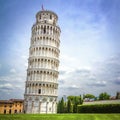
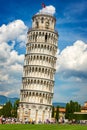
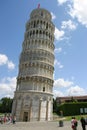
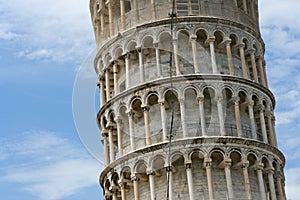
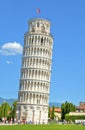
Officially the campanile, or bell tower, of the Cathedral in Pisa, the famous Leaning Tower began leaning soon after its construction was completed in 1173. Scientists now know that the tower began to lean because of a poorly laid foundation and loose substrate that shifted unevenly under the tremendous weight of the tower. It continued to gradually tilt until 1964 when the Italian government called for a group of engineers to solve the problem, lest its famous tilt might topple the tower completely. Their measures, however, were mostly uneffective and the tower began to tilt at an increasing rate until reaching 5.55 degrees. In 1990 it was closed to the public, several of its massive bells were removed, a cable around the third level was anchored to the ground, and 38 cubic meters of soil were carefully removed from underneath the raised end - this strategy worked and the tower returned to a'safer' tilt of 3.99 degrees. It reopened to the public in 2001.


Stockphotos.ro (c) 2025. All stock photos are provided by Dreamstime and are copyrighted by their respective owners.