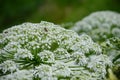
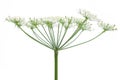
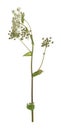
Heracleum sphondylium is a herbaceous, flowering plant. It is a tall, roughly hairy plant reaching up to 2 metres (6 ft 7 in) in height. The hollow, ridged stem with bristly hairs arises from a large tap root. The leaves can reach 50 centimetres (20 in) in length. They are once or twice pinnate, hairy and serrated,[3] divided into 3â5 lobed segments.Heracleum sphondylium is most commonly a polycarpic perennial plant,[4][5] not a biennial as sometimes claimed.[6] The flowers are arranged in umbels, either flat or slightly convex, 4â25 cm in diameter, usually with 10â25 hairy, somewhat unequal rays, each 2â12 cm long. Each flower has five white or rarely pinkish-white to purplish petals.[3] The central flowers of the umbel have radial symmetry (actinomorphic), while the flowers around the perimeter of the umbel have bilateral symmetry (zygomorphic) since the outermost petals are enlarged.[7][8] The winged fruits are flattened schizocarps,[8] elliptical to rounded and glabrous, about 7â12 mm long.[7][3]The characteristic 'farm yardy' smell or the observation that pigs would eat the foliage and roots of hogweed is perhaps the origin of its common name.[9]Heracleum sphondylium is smaller than Heracleum mantegazzianum (giant hogweed) and Heracleum sosnowskyi (Sosnowsky's hogweed). It contains some of the same phytophototoxic compounds (furanocoumarins), albeit at much lower concentrations,[10] and there is evidence that the sap from common hogweed can also produce phytophotodermatitis (burns and rashes) in sensitive individuals when contaminated skin is exposed to sunlight.
|