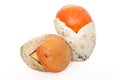
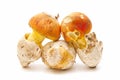
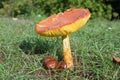
Amanita caesarea is a species of the Mediterranean Region, where it is a widely desired edible. In the Americas there are very similar sister species known primarily from Mexico one from the eastern US lacks the bright colors common to the others; together with A. caesarea, they form a distinct taxonomic groupâââ‰â¬Âstirps Caesarea. While it has not yet been proven or disproven that all species of section Vaginatae with rings have a common ancestor, it seems to be the case that the group of taxa with great similarity to Amanita hemibapha Berk. & Broome Sacc. stirps Hemibapha do indeed have a common ancestor with stirps Caesareaâââ‰â¬Âbased on both macroscopic and microscopic morphological evidenceâââ‰â¬Âprimarily by having similar subhymenia that suggests plant tissue due to being composed of inflated cells; the frequent appearances of red, orange, and yellow as dominant colors; the presence of a felted internal limb of the volva fragments of which decorate the stem at maturity; spores that are usually broadly ellipsoid to elongate; and temperate to tropic distribution. To date, molecular evidence is also supportive of the hypothesis of a common ancestor.
|